Drying walls, floors and framing

Structural Drying and Dehumidification in Barrington, NJ

Wet walls, subfloors and framing keep holding water once the puddles are gone, so the drying team sets air movers and dehumidifiers and takes readings until every material reaches its dry goal.

(888) 471-9821Get help drying a wet structure
Fans and LGR units Desiccant units Psychrometric drying logs
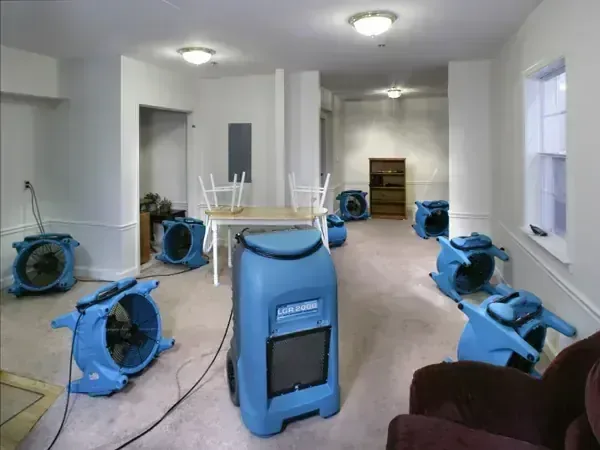
Several air movers and one large dehumidifier set up in an open room to dry it
This loss at a glance
EquipmentAir movers, LGR, desiccant
Measured byDaily moisture readings
StandardIICRC S500
TargetsFraming, subfloor, slab
First moves

Structural Drying and Dehumidification: what to do before the crew arrives

  1. 1
    Stop the source

    Fix the leak or let the flood recede first, because drying cannot finish otherwise.

  2. 2
    Remove the water

    Extract standing water so the equipment works on moisture in materials, not puddles.

  3. 3
    Keep it running

    Leave equipment on and doors closed, since stopping early leaves moisture behind.

  4. 4
    Expect return visits

    The crew returns to read meters and move equipment.

Order of the work

How structural drying and dehumidification is handled in Barrington, NJ

Measure, extract, dry, verify: skipping a step is how hidden moisture ends up sealed inside a wall.

  1. 1

    Map the moisture

    Meters and a thermal camera mark every wet material, and a dry reference sets the goal.

  2. 2

    Set the equipment

    Dehumidifiers and air movers are sized to the room and aimed at the wettest materials.

  3. 3

    Read every day

    Moisture content, temperature and humidity are logged each visit, and equipment is moved as the readings change.

  4. 4

    Confirm dry

    Once every material matches the dry reference point, the equipment goes and the log is handed over.

Typical cost ranges

What does structural drying and dehumidification cost in Barrington, NJ?

Drying one or two rooms usually costs $1,500 to $3,500. Hardwood floors and multi room jobs move to $3,500 to $7,000, and Class 4 drying of block or plaster runs $7,000 to $10,000.

One or two rooms, Class 1 or 2

$1,500 to $3,500
  • Air movers and LGR
  • Daily readings
  • Drying log

Hardwood or several rooms

$3,500 to $7,000
  • Floor mat systems
  • Wall cavity drying
  • Psychrometric logs

Class 4, block or plaster

$7,000 to $10,000+
  • Desiccant dehumidifiers
  • Extended run time
  • Full documentation

Ranges move with the water category, the square footage, the material class and how fast drying started. For a planning number, run the water damage cost calculator.

Drying is not finished when a surface feels dry. Framing, subfloor, plaster and concrete hold moisture inside, and a wall that reads dry on the outside can still be wet in the cavity. Structural drying is the part of a water job that is measured, adjusted and documented every day.

The housing this applies to

Barrington's median home was built in 1960, and the Census counts 1,080 homes from the 1950s and 788 from the 1960s, together more than half of the housing. The borough also has many apartment buildings, where water from one unit can reach framing and finishes in the next.

How the equipment is chosen

  • Refrigerant LGR units handle most rooms with ordinary moisture loads
  • Desiccant dehumidifiers dry dense materials such as hardwood, block and plaster
  • Air movers are placed by room size and adjusted as the readings change
  • Mat systems under hardwood draw water out through the boards, so the floor is not torn up

What the daily readings show

Each visit records moisture content in representative materials, plus temperature and humidity in the room, and the numbers are compared with an unaffected dry reference. When the wet materials match it, the equipment comes out. That log is what an insurer or a buyer later sees as proof of a complete dry-out.

After storms or long leaks, see storm flood cleanup and water extraction for the stages that come before drying. Drying should start as soon as the standing water is removed, because every extra day lets moisture spread deeper into framing.

Service area

Structural drying and dehumidification across the area and nearby towns

Service area around the town

Structural drying runs in homes, apartment buildings and commercial spaces across the borough, including the 1950s and 1960s housing that makes up more than half of the homes and the buildings along Clements Bridge Road.

The same service nearby: structural drying and dehumidification in Mount Laurel, Haddon Heights, Audubon.

Every water service in this town · every town covered

Questions

Structural Drying and Dehumidification questions in Barrington, NJ

How is a wall shown to be dry?

A moisture meter reading on the wall is compared with a dry reference from an unaffected wall. When they match, and the readings hold, the wall is dry.

Why are fans running if the floor feels dry?

Surface dryness hides moisture in the subfloor, framing and wall cavities. Air movers and dehumidifiers keep working until the meter readings, not touch, say the materials are dry.

What is the difference between LGR and desiccant dehumidifiers?

LGR units pull moisture from the air with refrigeration and suit most rooms. Desiccant units use a drying wheel and suit cool, very wet or dense plaster and block.

Can hardwood floors be dried instead of replaced?

Often, if the water is caught early. Floor mat systems pull water through the boards, though boards that have already cupped or buckled may not return to flat.

How long does structural drying take?

Most jobs need several days, and dense materials or a long wet period can stretch that. The daily readings set the end date, and a drying log records every visit.

Why does drying need to start quickly?

Wet materials can begin to grow mold within a day or two, so fast drying protects the structure and the air quality.

Water in the house right now

Dry to the surface is not dry all the way through

Starting the equipment early and following the readings protects the framing, subfloor and finishes you want to keep.

(888) 471-9821Start the drying
(888) 471-9821 flood & leak help