The science behind every dry-out

Structural Drying and Dehumidification in Mount Laurel, NJ

Dry to the touch is not dry. The drying team measures framing, subfloor, hardwood and block walls against a dry reference and runs air movers and dehumidifiers until every reading reaches the goal.

(888) 471-9821Floors and walls still damp? Call now.
Readings against a dry reference LGR and desiccant dehumidifiers Daily psychrometric logs
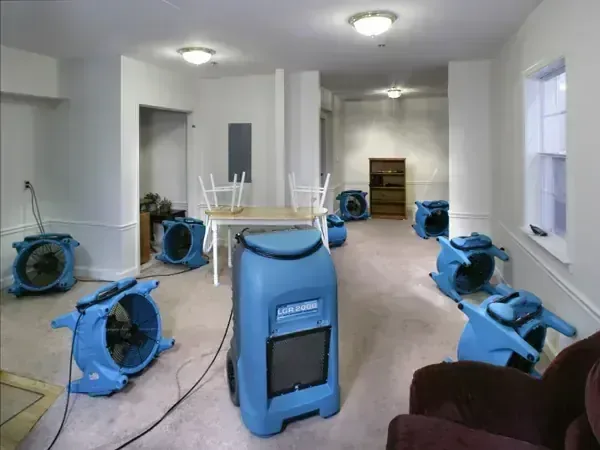
Air movers and an LGR dehumidifier drying an open room toward the S500 goal
This loss at a glance
Drying goal2 to 4 points of a dry reference
Main gearLGR, desiccant, air movers
Typical drying3 to 7 days
Drying standardIICRC S500
First moves

Structural Drying and Dehumidification: what to do before the crew arrives

  1. 1
    Stop the water

    Drying cannot start while the source is still running.

  2. 2
    Close the windows

    Outside air adds humidity; the drying team controls the air instead.

  3. 3
    Keep the heat steady

    Normal room temperature helps the dehumidifiers work.

  4. 4
    Leave the equipment running

    Turning air movers or dehumidifiers off overnight adds days to the job.

Order of the work

How structural drying and dehumidification is handled in Mount Laurel, NJ

Measure, extract, dry, verify: skipping a step is how hidden moisture ends up sealed inside a wall.

  1. 1

    Set the reference

    A dry reading from unaffected material in the same house becomes the target.

  2. 2

    Size the equipment

    Air movers and dehumidifiers get set to the class of loss and each room's load.

  3. 3

    Read and adjust daily

    Readings get logged every day, and equipment moves to what is still wet.

  4. 4

    Pull out at the goal

    Equipment leaves when materials read within 2 to 4 points of the reference.

Typical cost ranges

What does structural drying and dehumidification cost in Mount Laurel, NJ?

In the township, structural drying typically runs $1,500 to $10,000, depending on the class of the loss, the materials involved, how many rooms need equipment and how many days the drying runs.

One or two rooms, Class 1 or 2

$1,500 to $3,500
  • Air movers and LGR
  • Daily readings
  • Drying log

Hardwood or several rooms

$3,500 to $7,000
  • Floor mat systems
  • Wall cavity drying
  • Psychrometric logs

Class 4, block or plaster

$7,000 to $10,000+
  • Desiccant dehumidifiers
  • Extended run time
  • Full documentation

Ranges move with the water category, the square footage, the material class and how fast drying started. For a planning number, run the water damage cost calculator.

Water damage is a structure problem. Framing, subfloor, hardwood, plaster and concrete block absorb water and hold it long after carpet feels dry, and moisture sealed into a wall feeds odor, swelling and growth later. Structural drying is the part of the job that removes it, measured with meters rather than judged by touch.

How drying is planned

  • Class 1 to 4 sets how much evaporation the room needs and how much equipment goes in
  • Air movers aimed along walls and under cabinets to move moist air off wet surfaces
  • LGR dehumidifiers for most rooms, desiccants for dense materials and cool basements
  • Floor mat systems that pull water out of hardwood before it cups

Reading the goal

The tech who does the walkthrough takes a dry reference reading from an unaffected part of the same material, then logs wet readings every day. Equipment moves to what is still wet and comes out when materials read within 2 to 4 points of that reference. Psychrometric readings of temperature and humidity show the dehumidifiers are pulling water out of the air.

Seasons and houses here

Muggy summers make open windows a bad idea during a dry-out, and cold winters slow evaporation in basements and crawl spaces, so the drying team closes the house and controls the air instead. The EPA indoor air quality pages cover why indoor humidity matters, and the USDA Forest Products Laboratory publishes research on how wood takes up and gives off moisture.

For a rough number on your own materials, try the drying time estimator.

Service area

Structural drying and dehumidification across the township and nearby towns

Burlington County, ZIP 08054

The restoration team covers ZIP 08054 across the township, from Rancocas Woods and Ramblewood to Birchfield, Pine Grove, Heulings Hill, Fellowship and the homes off Union Mill Road and Hartford Road.

Nearby coverage takes in Moorestown, Maple Shade, Cherry Hill, Evesham Township, Hainesport, Lumberton.

Every section and town covered

Questions

Structural Drying and Dehumidification questions in Mount Laurel, NJ

Why does drying take several days if the floor feels dry?

The surface dries first. Framing, subfloor and block hold water inside, and meters show it long after the surface feels dry.

What is the difference between LGR and desiccant dehumidifiers?

LGR units cool the air to condense water and suit most rooms. Desiccant units use a drying material and work better in cool spaces and on dense materials like hardwood and block.

Can hardwood floors be saved?

Often, when drying starts fast. Floor mat systems pull water up through the boards, and readings track the wood as it dries. Boards that cupped badly may still need sanding or replacing.

Why do the windows have to stay closed?

Outside air brings in humidity, especially in summer. A closed house lets the dehumidifiers control the air and dry faster.

How is dry decided?

By readings: wet materials are dry when they read within 2 to 4 points of a dry reference in the same house, and the log shows it.

Is the drying equipment noisy?

Air movers and dehumidifiers make a steady fan noise and run around the clock. Turning them off slows the drying.

Water in the house right now

Walls and floors still wet? Get them dried to the goal.

Readings, not guesses: equipment stays until every wet material matches its dry reference.

(888) 471-9821Put the drying equipment in place
(888) 471-9821 flood & leak help