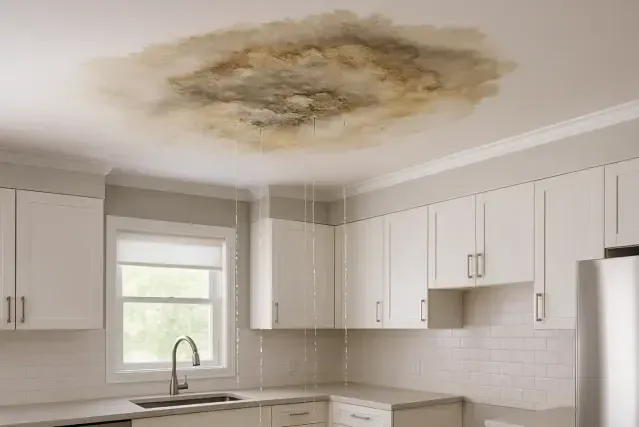
A brown stain spreading across a ceiling usually means water is coming from somewhere above, and in Audubon that somewhere is often another home. Hundreds of the borough's homes sit in two unit buildings and apartment buildings, so the leak and the stain can belong to different households.
Key takeaways
- A ceiling stain often traces to the unit or floor above, so the source may be in someone else's home.
- The 2020 to 2024 survey counts 437 housing units in two unit buildings, 77 in buildings of three or four units and about 311 in buildings of 10 or more units.
- The survey counts 803 renter households, so a landlord is often part of the conversation.
- Tracing the leak, opening the ceiling and drying behind the drywall happen in both units when water crossed between them.
- Photos, dates and drying records help every household involved.
Why a ceiling stain often starts above
Water moves down and sideways until something stops it. A ceiling is often the first surface that shows the result.
The visible stain is the end of the path, not the start. The source can be a bathroom, a laundry room or a kitchen one floor up.
That is why a ceiling leak cleanup begins with tracing, not with paint.
Ceilings also hide leaks. Drywall can hold water for a while and then show a stain, a bubble or a sag all at once.
That delay is why a ceiling can look fine at breakfast and drip by dinner.
What the Audubon housing counts show
The 2020 to 2024 American Community Survey gives a picture of how homes are arranged in the borough. About 3,465 housing units are in the survey.
- 2,465 are detached single family homes and 175 are attached single family homes.
- 437 units are in two unit buildings, and 77 are in buildings of three or four units.
- About 311 units are in apartment buildings of 10 or more units, including 167 in buildings of 50 or more.
- 2,579 households own their home and 803 rent, or about 76 percent owner occupied and about 24 percent rented.
What that mix means for a leak
Shared ceilings and floors are common enough that every ceiling stain deserves a look upstairs. Even in a detached home, the floor above can be the source, such as a second floor bathroom.
Both a townhome and condo water damage job and a single family ceiling leak start with the same question: where is the water coming from?
Common sources above a wet ceiling
The median home in the borough was built in 1938, so plumbing in older homes can be aging. Most ceiling leaks, though, start with ordinary household equipment, the kind handled in an appliance leak cleanup.
- Washer hoses, dishwashers and ice maker tubing that leak under floors and cabinets.
- Tub and shower overflows or failed seals on an upstairs bathroom floor.
- Toilet supply connections and toilet wax seals.
- A water heater leaking into a closet or utility space.
- A supply or drain pipe that has worn out inside a wall or floor.
What to do first
Where the leak started decides which steps come first, so it helps to know which side of the ceiling a household is on.
If the stain is on the ceiling below
Place a bucket under any drip and move furniture out of the way. Turn off power to a fixture that is wet or sagging.
Photograph the stain, then tell the household above and the landlord or manager.
- Do not poke a bulging ceiling unless water is dripping and a bucket is ready.
- Keep people out from under a sagging section.
If the source may be in the unit above
Shut off the water to the suspected fixture or appliance, or at the unit shutoff. Wipe up standing water and open cabinet doors to let the area breathe.
Then let the household below know, and give access once a drying team asks.
- Do not wait to see if the stain grows.
- Keep the receipt and a photo of any broken part.
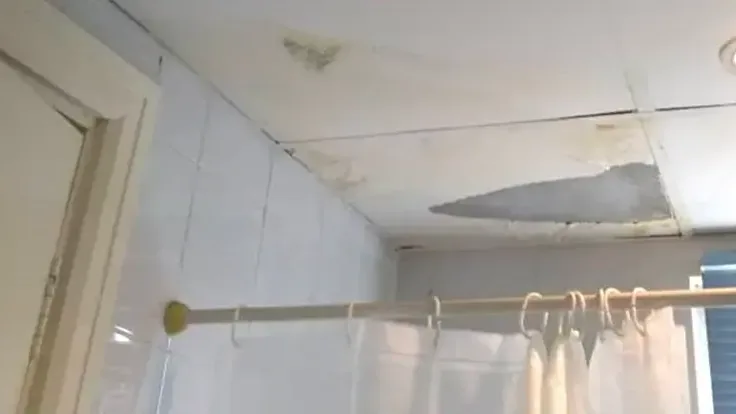
Landlords, neighbors and shared costs
With 803 renter households in the survey, many ceiling leaks involve a lease. A landlord or manager usually controls the building shutoffs and repairs.
Who handles what depends on the lease or the community documents, so written notes and photos with dates are worth keeping.
- Send the landlord or manager a short written note with photos.
- Ask who will authorize the drying work and the repairs.
- Keep copies of every message, including the date and time.
How leak tracing and drying work
When water has crossed from one unit to another, each unit needs its own readings, its own drying setup and its own records.
A wet ceiling is rarely a one room problem. The local water damage restoration team checks the walls beside it and the floor above before calling a job complete.
Tracing the source
The restoration team uses moisture meters and a thermal camera to follow the water to where it started. The source is stopped before the drying begins.
Opening the ceiling
Wet drywall and insulation are cut out where readings show water. The ceiling is opened only as far as the readings require.
Drying both sides
Air movers and dehumidifiers dry the ceiling and joist bay from below, and the floor above is dried from the other side. Daily readings show when each side is dry.
Small checks that prevent the next ceiling leak
Most ceiling leaks start with something that was easy to check. A few minutes of attention can head one off.
- Look at washer hoses and replace any that bulge, crack or show rust at the fittings.
- Check under sinks and behind toilets for damp cabinet floors or soft flooring.
- Watch tub and shower caulk, since a gap lets water reach the floor below.
- Learn where the unit shutoff and each fixture shutoff are.
- Tell the landlord or manager about a stain early, even a small one.
For renters
A written note with a photo creates a record. If a stain grows, the dates show how long the problem has been present.
For owners
An owner of a two unit building or an apartment unit can ask the neighbor above to check hoses and seals, since a failure there lands on the owner below.
Questions
Why does a ceiling leak often come from the unit above?
Water moves down and sideways, and plenty of Audubon homes sit in two unit buildings or apartment buildings where one household's floor is another's ceiling.
What do the survey counts say about Audubon housing?
The 2020 to 2024 survey counts 437 units in two unit buildings, 77 in buildings of three or four units and about 311 in apartment buildings of 10 or more units.
Who should be told first about a leak from upstairs?
The household above and the landlord or manager. A written note with photos and a date gives everyone the same information.
Does the ceiling always have to be opened?
Not always. Readings decide whether a ceiling can be dried in place or whether wet drywall and insulation must be cut out.
Can a leak start somewhere other than an apartment?
Yes. In a detached home a second floor bathroom, an attic water heater or a roof leak can send water to the ceiling below. The drying team traces the actual path before opening anything.